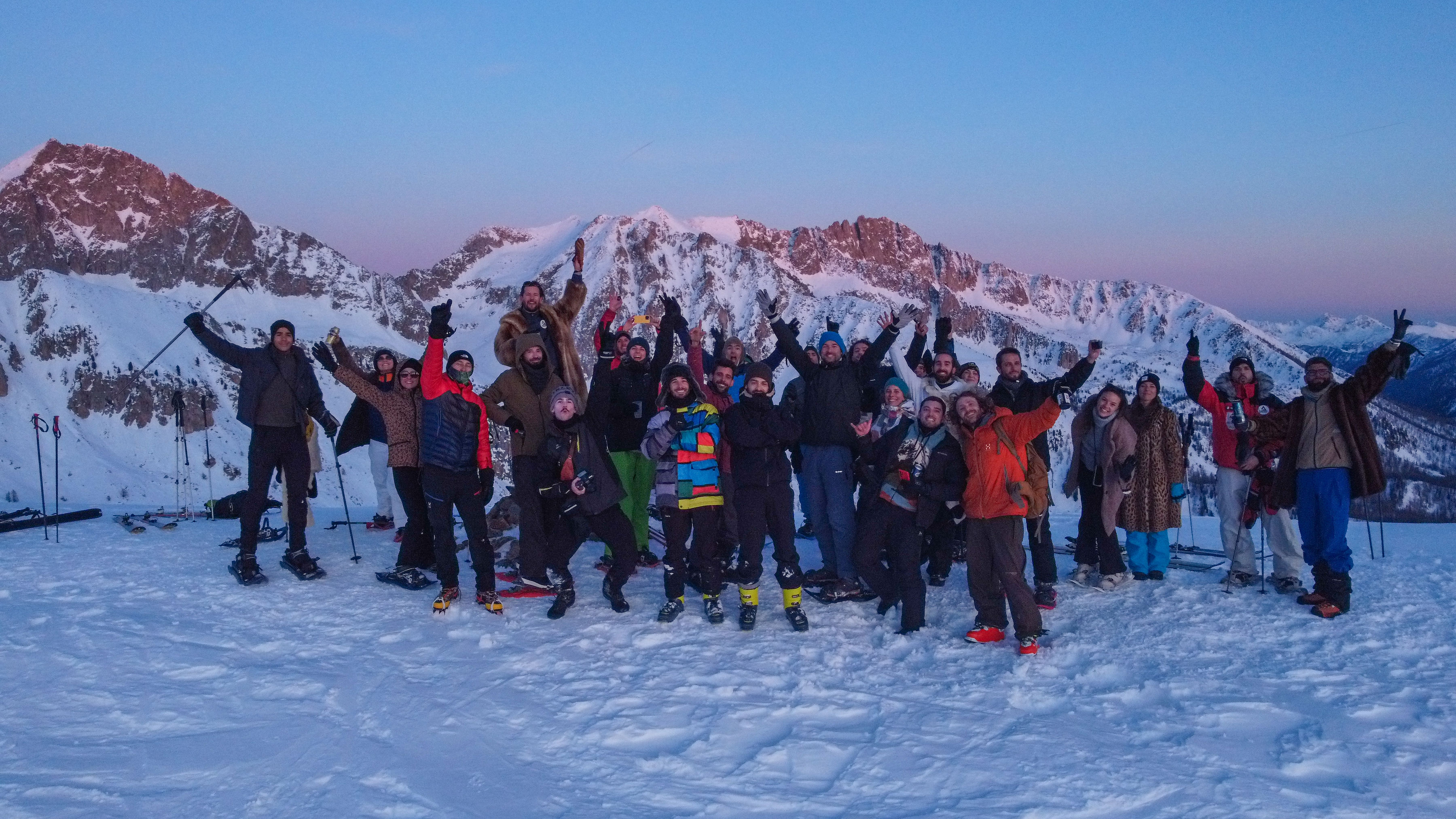
Organizing a corporate team building event is, above all, a matter of construction. Choosing a venue, setting a budget, selecting team building activities, defining objectives, coordinating participants, and structuring a cohesive day; every decision counts and is part of a precise sequence.
But without a clear method, the organization can quickly become blurry. You accumulate ideas, hesitate between several formats, and in the end, you build something decent, without really knowing if it will create a memorable moment, an unforgettable moment.
That is precisely where it all comes down to: in the way you build your event, step by step, to create a moment that your team will truly experience, share, and remember.
↪️ In this article, we will show you concretely how to organize a corporate team building event step by step, by structuring each phase to create a cohesive and impactful experience for your team!
Why organize a corporate team building event?
Before getting into the practical "how-to," it is important to clarify the role that this type ofevent plays in the life of a company.
To build connections and structure team dynamics
The team building is not limited to an activity or a simple day out of the office. It is part of a broader strategy that consists of creating favorable conditions for exchange and collaboration.
In daily work life, interactions are often quick, focused on performance and objectives. Organizing a team building event allows you to set a different framework, where employees can interact differently, understand each other better, and strengthen existing bonds.
In this environment, discussions change, postures evolve, and certain conversations emerge that would never have taken place at the office. And it is precisely by stepping out of classic formats and offering experiences that are more embodied, led by passionate people, and rooted in genuine encounters and authentic moments, that these exchanges take on another dimension and leave an unforgettable and lasting impression!
To strengthen cohesion and collective efficiency
A B2B team building event that is well-organized doesn't end when the event itself is over. It’s not just about creating a pleasant moment, but about delivering an experience that continues to resonate long after the day is done.
Key benefits include:
- Strengthening your team's cohesion.
- Improving communication between employees.
- Boosting motivation and workplace engagement.
- Fostering cooperation and collective intelligence.
- Creating a healthier and more seamless work environment.
🌍 Good to know: the clearer your planning is beforehand, the more your team can focus on what really matters on the big day: experiencing something together.
Organizing a corporate team building event: 7 steps to success
Organizing a corporate team building event follows a simple logic: move step-by-step to build an event that truly delivers. This process helps avoid guesswork and allows you to create a team building activity that makes sense, both on paper and on the day of the event.
To help you organize a team building event that is structured, seamless, and truly impactful for your team, here are the 7 steps to follow:
1️⃣: Analyze your team and the context
Before even talking about team building activities, you need to go back to basics: your team. This is where it all begins.
Who are the people who will be participating? How do they work together today? Is there already good cohesion, or are there tensions, silos, and teams that rarely talk to each other?
This step requires taking a step back, and above all, looking at your team outside of its usual setting, where everything is often defined by work. You can talk to a few employees, gauge expectations, or simply observe existing dynamics. The goal isn't to conduct a complex study, but to understand the current state of your team and what it truly needs.
It is also the time to identify constraints : number of participants, availability, budget, and timing during the year. All these elements will influence what comes next, sometimes more than you might think.
👉🏻 It is often in these moments that you realize a team functions not just on roles, but on connections.
2️⃣: Define precise and useful objectives
Once you know who you are addressing, you can clearly define what your team building should trigger. Without an objective, you risk organizing a pleasant day that lacks real impact, missing out on what you truly wanted to create. Ask yourself a simple question: what do you want your team to experience, and more importantly, what do you want to change afterward?
You might want to, for example:
- Strengthen your team's cohesion.
- Improve communication flow.
- Support a period of change.
- Create a moment to relieve pressure.
Avoid being too vague. The clearer your objective, the more consistent your subsequent choices will be. ✔️
In practical terms, take the time to write them down in black and white before going any further with your planning. It may seem simple, but it changes everything in how you will build your event. A good objective serves as a common thread for your entire organization, from the beginning to the big day.
Because a successful team building event isn't just a good day. It’s a moment that creates a before and an after.
3️⃣ : Choose a venue that creates an experience for your team
We often think of a venue as just a logistical detail. A practical, accessible spot that ticks all the boxes. But in reality, it’s never neutral. It’s the first signal you send to your team. It sets the tone before the first activity even begins and influences the group's energy the moment they arrive.
A standard, soulless venue naturally puts everyone in a work mindset. Conversations remain cautious, topics stay within the usual bounds, and the "out-of-office" feeling quickly fades away.
Conversely, a venue chosen for the experience it offers changes the dynamic completely! A place where something is happening, an environment that sparks curiosity, a setting that encourages people to open up a little more than usual.
It doesn’t necessarily have to be further away or more expensive; it just needs to tell a story. A vibrant neighborhood, an unconventional space, or a place with a rich history or passionate hosts—these are often the details that elevate the experience. ✨
Ultimately, the real question isn't "where should I host my team building?" It's: does this place inspire people to share an experience, or just to tick off activities? Because team building doesn't start with the agenda; it starts the moment your team arrives.
4️⃣ : Build a schedule that gives the day a natural flow
Once the venue is set, you can structure the day. This is often when people tend to overdo it, trying to fill every slot with an activity to maximize the time. 👀
The risk is creating a day that looks packed on paper but is exhausting for your team. A good team building event isn't about piling on activities, but about a rhythm that allows everyone to get involved without feeling rushed.
The ideal approach is to think of the day as a progression:
- A start that allows participants to arrive at their own pace, disconnect from work, and shift into a different mindset.
- Then, a core part of the day that is more engaging, where activities take center stage and the team truly comes together.
- Finally, more open-ended moments where conversations become more natural.
It’s often during these less structured times that the real magic happens. Conversations linger, groups mix organically, and connections emerge that would never have happened in a more formal setting!
Building a good schedule isn't about filling up the day, but creating the conditions so the team can fully experience every moment.
5️⃣ Choose activities that create a genuine connection
This is usually the stage where you spend the most time, looking for an original team building idea, comparing formats, or hesitating between several options. However, the real question isn't so much about which activity to choose, but what it will help create.
A relevant activity is one that gets people interacting with each other. What leaves a lasting impression isn't just what the employees do, but what they experience together during that time. 🫱🏻🫲🏼
Some formats are particularly effective for this. Immersive experiences, which require cooperation, naturally push teams to organize themselves differently. Participatory workshops allow everyone to find their place and contribute. Experiences led by passionate local guides bring a more human, authentic, and memorable dimension because they are based on a real connection.
What often makes the difference is the ability to create a genuine encounter, spark sincere exchanges, and step outside the usual work environment without it feeling forced.
🌍 Our advice: always prioritize an activity that fosters interaction and conversation over a format that is impressive but not very engaging for the team.
6️⃣ Streamline the logistics so everything happens naturally
Even with a great venue and well-chosen activities, the experience can quickly be affected by logistical details. These are rarely visible at first glance, but they strongly influence how the day is experienced.
Poorly adjusted timing, poorly anticipated travel, or a transition that drags on can break the rhythm and drain the group's energy. Conversely, when everything is seamless, participants don't have to worry about anything and can focus entirely on the moment.
The goal isn't to control every single detail, but to make the whole thing natural enough so thatthe logistics fade into the background, allowing the experience to take center stage. This requires careful planning of schedules, travel, break times, and coordination between the different stages of the day. 🗃️
This groundwork is often invisible, but it allows your team to experience the team building without friction, with a sense of flow that makes all the difference.
7️⃣ Extending the momentum after your team building event
We often tend to think that a team building event ends as soon as the day is over. In reality, its impact depends heavily on what happens next.
What your team takes away isn't just about the logistics or the activities themselves, but the shared moments and the connections that were formed. To make that impact last, it’s important to extend the experience.
This can be done through simple actions, like revisiting highlights, sharing photos, or checking in with team members about how they felt. These elements help revive the experience and anchor the effects of the team building in everyday work life.
With a little perspective, this is often where you truly measure the event's impact. Conversations become more natural, certain barriers come down, and the team dynamic gradually evolves.
A successful team building event doesn't stop on the day itself. It continues to live on through the interactions it made possible.
Activity ideas for an unforgettable corporate team building event
Once your logistics are in place, the question of choosing the right team building activities becomes central. But rather than looking for "the best idea," it is often more relevant to think about the types of experiences you want your team to have.
On MeetPeople, our experiences are designed to break away from traditional formats and offer more authentic moments rooted in real encounters, unique places, and stories. The goal isn't just to run through a series of activities, but to create lively moments driven by human connection, where team members can interact in new ways, share something tangible, and naturally strengthen their cohesion.
With this in mind, several formats can be particularly effective for a corporate team building event. Some teams might enjoy an immersive neighborhood tour with a local guide, discovering a place through the eyes of someone who lives there every day. Others might prefer a craft or creative workshop, where everyone participates, experiments, learns, and chats in a more informal setting.
Culinary experiences also work very well, especially when led by an enthusiast sharing their expertise.
It’s no longer just an activity, but a moment of connection that easily brings participants together. Conversely, more immersive or unconventional formats can shake up routines, encouraging the team to cooperate differently and step outside their usual way of working.
What matters is not so much the format chosen, but what it allows you to create. A conversation that starts naturally, a shared moment that lasts, or a new dynamic that takes hold without needing to be forced.
🌍 Our advice: always prioritize experiences that foster interaction, connection, and participant involvement, rather than formats that are too passive or standardized.
👉🏻 If you want to take it further, you can explore MeetPeople experiences and envision moments designed to be experienced, shared, and used to build real bonds within your team.
Conclusion
Organizing a corporate team building event isn't just about planning a day or choosing activities; it’s about building, step by step, a cohesive experience designed for your employees, their daily reality, and the bonds you want to strengthen between them.
When every element is aligned (the objectives, the venue, the experiences, the pace), the event becomes more than just a meeting. It sparks different types of conversations, strengthens bonds, and leaves an impact that lasts well beyond the day itself.
Ultimately, a successful team building event is not measured solely by what was planned, but by what your team takes away from it: a connection, an emotion, a shared story, and sometimes a new way of working together.
FAQ
Team building vs. seminar: what’s the difference?
The corporate seminar is generally work-oriented, featuring meetings, presentations, or strategic workshops. Team building, on the other hand, focuses more on cohesion, interaction, and shared moments among colleagues.
The two are complementary but serve different purposes. Team building is primarily aimed at strengthening your team's cohesion, while a seminar is more focused on management and decision-making!
What types of games can liven up downtime during a team building event?
Downtime can be the perfect opportunity to incorporate simple, effective games to maintain good energy without disrupting the flow. Brain teasers, quick challenges, or light collaborative activities work particularly well.
The idea isn't to overload the day, but to offer activities suited to the moment that keep participants engaged while maintaining a smooth experience.
What mistakes should you avoid when organizing a B2B event?
Organizing a B2B event, whether it's a team building session or a corporate seminar, requires making the right choices at every stage.
Certain mistakes happen regularly, such as failing to define clear objectives, choosing an activity that doesn't resonate with the team, or neglecting the overall pace of the day. To ensure you don't miss the mark, check out our article on the 10 mistakes to avoid when organizing a B2B event, which details the key points to anticipate for a successful experience!