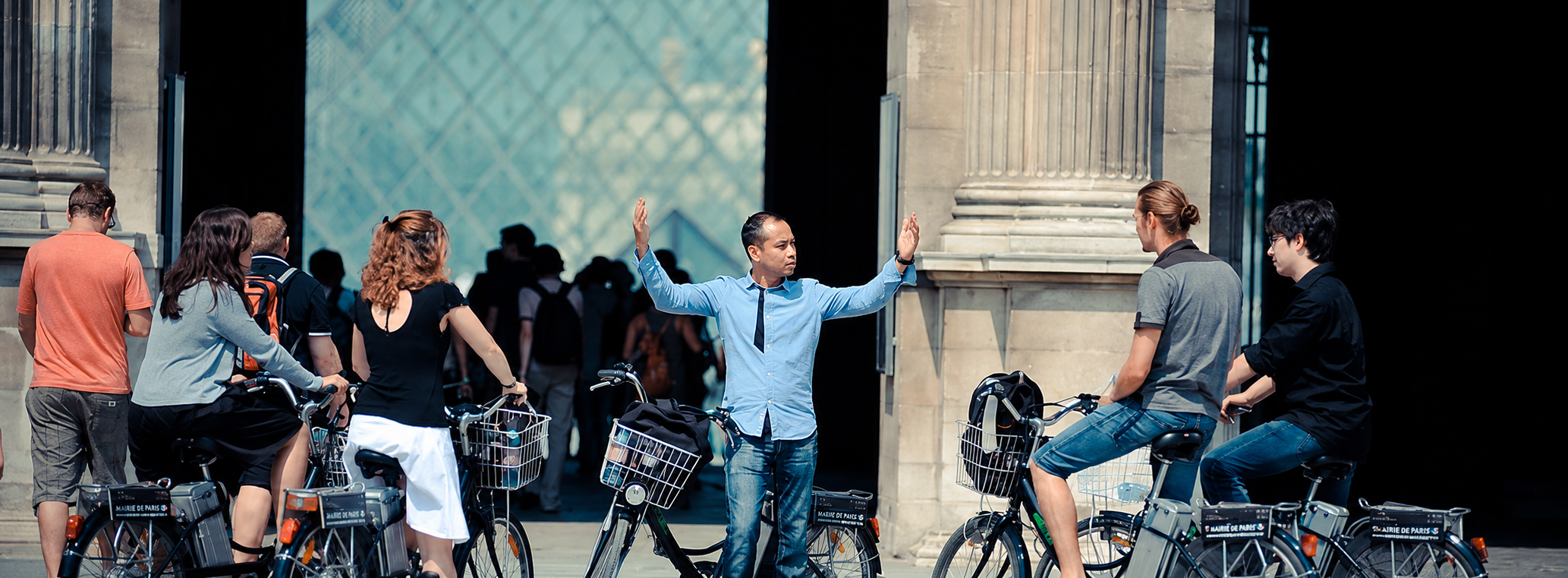
Guided tours and local experiences aren't opposites. Both let you discover a city, a region or a culture, but they don't always focus on the same things.
On one hand, a guided tour is often built around passing on knowledge. On the other, a local experience usually adds a more personal, participative and human dimension.
So should you choose a guided tour or a local experience? It mostly depends on what you're looking for during your trip.
The guided tour: understanding a place
A guided tour is generally designed to pass on knowledge about a destination.
The guide leads participants along a set route and shares information about the history, heritage, architecture, culture or figures linked to the place.
It's a particularly good fit if you want to:
- quickly get a sense of a city
- discover the main landmarks
- learn the history of a neighbourhood
- put a place into its cultural context
- pick up specific stories and anecdotes
- visit with someone who's an expert on the subject
A guided tour gives you real structure.
It's especially useful on a first trip to a destination, since it helps you quickly get your bearings.
The local experience: living something more personal
A local experience can also include an element of touring, but it usually goes further.
It aims more at living a moment than simply passing on information.
This can take the form of:
- an encounter
- a creative activity
- a tasting
- an outdoor outing
- a sports activity
- a themed walk
- a workshop
- an immersion in a neighbourhood
- a conversation with someone who deeply knows their region
A local experience often rests on a more direct relationship between the traveller and the person offering the activity.
The programme can sometimes be more flexible, more spontaneous and more closely tied to the personality of the guide or enthusiast.
The main difference: watching or taking part
The difference between a guided tour and a local experience often comes down to the level of participation.
On a classic guided tour, the traveller listens, watches, asks questions and follows a route.
In a local experience, they might be asked to:
- create something
- cook
- taste
- practise a skill
- walk
- take photos
- meet other people
- learn a technique
- chat more freely with the host
The experience becomes more participative.
It's no longer just about what you see, but also about what you do and how you live it.
The guide's role isn't quite the same
On a guided tour, the guide is usually chosen for their expertise on a subject or a place.
They structure the visit, pass on information and lead participants along a clear thread.
In a local experience, the person's personality can matter even more.
You're not just choosing an activity.
You're also choosing someone:
- for their story
- their passion
- the way they talk about their region
- their know-how
- their energy
- the way they share what they know
This is an important difference.
Two people can offer a similar activity, yet create completely different experiences depending on their personality and approach.
Can a guided tour become a local experience?
Yes, absolutely.
The lines aren't always fixed.
A guided tour can turn into a local experience when it leaves more room for conversation, personalisation and genuine connection.
For example, a heritage walk might start as a classic tour and then move towards:
- a tasting
- meeting an artisan
- discovering local addresses
- a workshop
- a more personal conversation with the guide
So the difference doesn't necessarily come from the type of activity, but from how it's experienced.
Example: discovering Bordeaux through local eyes
In Bordeaux, a tour might focus on heritage, landmarks and the city's history.
But a local experience can add another layer.
It might, for example, let you discover the Capucins, Sainte-Croix and Saint-Michel neighbourhoods through their atmosphere, cultural diversity and flavours.
👉 Discover a local experience in Bordeaux
In this kind of format, the traveller isn't just following a route.
They're also discovering the city through the sensibility of the person guiding them.
Example: visiting Toulouse like a local
In Toulouse, some experiences offer a very flexible way of discovering the city.
The programme can adapt to what the participant feels like doing. Architecture, hidden gems, food, secret spots or photogenic neighbourhoods can all be woven in depending on the moment.
👉 Discover "A slice of Toulouse with me"
This kind of experience feels less like a classic tour and more like a stroll with someone who really knows their city.
It's often exactly what travellers looking for something more personal are after.
Example: experiencing Marseille rather than just visiting it
In Marseille, some experiences combine the city, its heritage and the Mediterranean.
A discovery can start on land and then continue out at sea.
👉 Discover "Marseille, Land and Sea"
The experience then goes beyond simply passing on information.
It lets you feel the city from several different angles.
The guided tour: ideal for structuring your trip
A guided tour remains an excellent choice when you first arrive in a destination.
It often helps you to:
- quickly understand the history of the place
- identify the key neighbourhoods
- spot the main landmarks
- get useful context
- ask your first questions
- better plan the rest of your stay
It can therefore be particularly useful at the start of a trip.
The local experience: ideal for creating a memory
A local experience often brings a more emotional dimension.
You sometimes remember less the date a monument was built than a person you met, a workshop you took part in, or a conversation you shared.
This is where experiential tourism really comes into its own.
The memory doesn't only come from the place.
It also comes from what you lived through.
Which format should you choose, based on your travel style?
If you love understanding things
A guided tour may be the best choice.
It will give you structured information and help you better understand the area.
If you love taking part
Go for a local experience.
You'll be able to create, taste, walk, practise or chat.
If you're travelling solo
A local experience can be especially interesting, as it creates a moment of connection during your stay.
If you already know the destination
A very classic tour might sometimes offer less that's new.
A local experience can then help you rediscover the city from a completely different angle.
If you're travelling as a family
Both formats can work well.
The key is to choose based on the participants' ages, the length of the activity and the level of interaction you're after.
If you're travelling with friends
A participative activity may be a better fit for sharing a moment and creating memories together.
Why are local experiences becoming more and more popular?
Many travellers today are looking to step off the standard tourist routes.
They want to:
- understand how locals actually live
- discover lesser-known places
- meet people
- learn something
- support local businesses and creators
- live more personal moments
Local experiences answer this desire directly.
They put connection back at the heart of travel.
Experiential tourism: travelling by doing
Experiential tourism rests on a simple idea: you understand a place better when you take part in it.
Instead of simply watching, you do.
This can mean:
- cooking a local speciality
- creating a piece of art
- joining a photo walk
- discovering a traditional craft
- learning to identify local plants
- going out on the water
- taking part in a sports activity
The experience then becomes a way into the local culture.
Why not combine both?
You don't necessarily have to choose.
A trip can easily mix guided tours and local experiences.
For example:
Morning: a historical tour of the city centre.
Afternoon: a creative workshop or a chance to discover a local craft.
Evening: a food experience or a meeting with a local.
This combination lets you understand a destination while also living it.
How do you choose a good local experience?
Before booking, look at several things:
- who's offering the experience
- their background
- their passion
- the group size
- the duration
- the level of participation
- the practical details
- the meeting point
- what's included
It's also worth thinking about what you actually want to get out of the experience.
Do you want to learn? Meet people? Create something? Get moving? Taste something? Discover?
This question often helps you make the right choice.
Meet People: putting connection at the heart of discovery
Meet People lets you discover experiences offered by local guides, professionals and enthusiasts all across France.
The goal is to help travellers not just choose an activity, but also discover the person behind it.
Culture, heritage, sport, food, creativity, nature or wellbeing. Experiences can take many forms.
But they all share one thing in common: the desire to help you discover a place differently, through someone who knows it and wants to share it.
👉 Discover all Meet People experiences
Guided tour or local experience: what to remember
A guided tour is ideal for understanding.
A local experience is especially good for living, taking part and connecting with people.
But the two approaches can complement each other perfectly.
What matters most, in the end, is choosing a format that matches your own way of travelling.
Because beyond the place itself, it's often the people you meet and the moments you live that stay with you the longest.
👉 Discover all Meet People experiences